Table of Contents

For most first-time investors, buying a stock feels simple. Open a Demat account, select a company, place an order, and wait for the market to move.
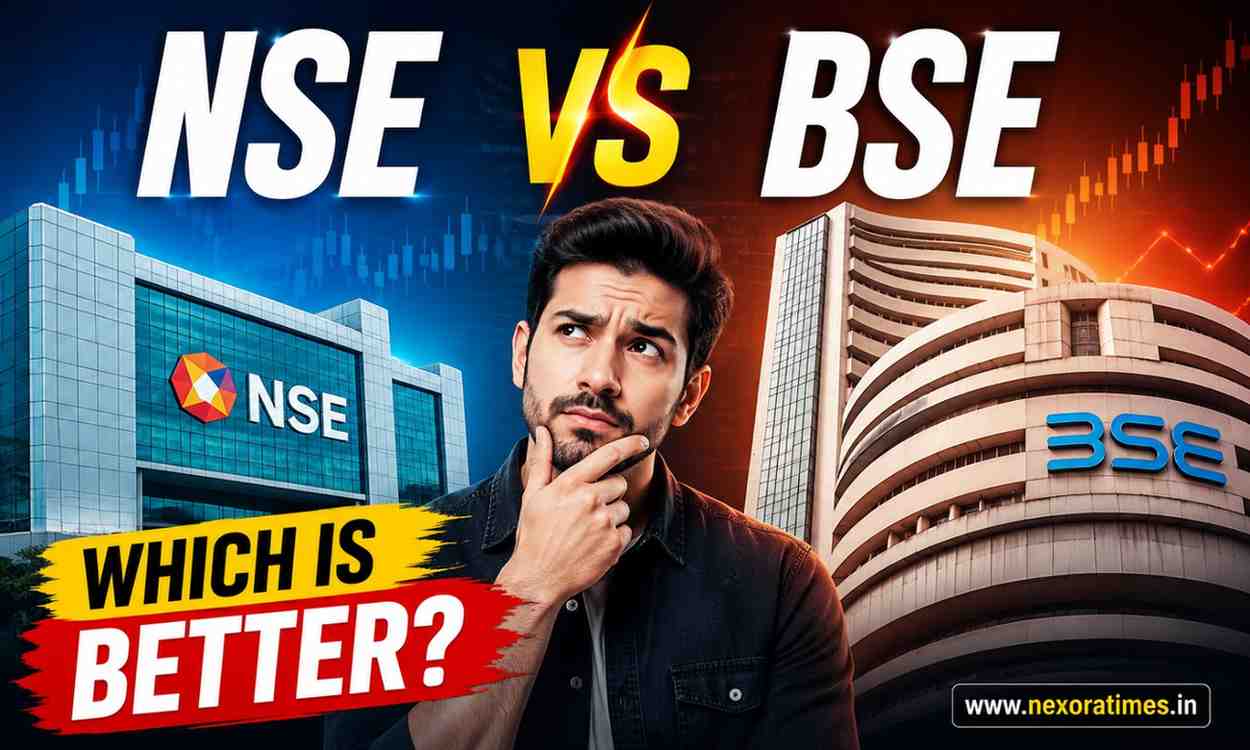
When you buy shares in India, you’re usually buying them through either the National Stock Exchange (NSE) or the Bombay Stock Exchange (BSE). At first glance, both seem almost identical. The same company shares often trade on both exchanges, and the prices look nearly the same.
However, the real conversation starts when investors discover that trading experience, liquidity, execution speed, and even stock availability can differ between the two.
That one detail has quietly become an important discussion point among new investors, especially as retail participation in the Indian stock market continues to grow.
What Are NSE and BSE?
- NSE (National Stock Exchange)
- BSE (Bombay Stock Exchange)
Both are regulated by the Securities and Exchange Board of India and provide a platform where investors can buy and sell shares, ETFs, bonds, and other securities.
While both exchanges perform a similar function, their market dynamics are not exactly the same.
NSE vs BSE: The Basic Difference
NSE
The National Stock Exchange was established in 1992 and has become India’s largest stock exchange in terms of trading volume. Its benchmark index is the NIFTY 50.
BSE
The Bombay Stock Exchange is India’s oldest stock exchange, founded in 1875. Its benchmark index is the BSE Sensex. BSE carries a strong legacy and hosts thousands of listed companies, including many smaller firms that may not be actively traded elsewhere.
The Difference Most New Investors Ignore
Liquidity Matters More Than Many Realize
Liquidity refers to how easily a stock can be bought or sold without significantly affecting its price.
For most large-cap stocks:
- NSE generally records higher trading volumes.
- Higher volume often means better liquidity.
- Orders may get executed faster.
- Bid-ask spreads are usually tighter.
This is one reason many active traders naturally prefer NSE.For long-term investors, the difference may not always be noticeable, but for frequent traders, liquidity can directly impact trading efficiency.
Why Many Traders Prefer NSE
Several factors contribute to NSE’s popularity:
Higher Trading Activity
Most daily equity trading in India takes place on NSE.
Better Price Discovery
Higher participation often leads to more efficient pricing.
Popular Among Derivatives Traders
Futures and options traders generally focus on NSE because of higher volumes and broader participation.
Faster Execution Experience
Higher liquidity often results in smoother order execution during market hours.
Where BSE Still Holds a Strong Advantage
Despite NSE’s dominance in trading volume, BSE remains highly relevant.
Larger Number of Listed Companies
BSE hosts a wider universe of listed companies, including many small and mid-sized businesses.
Historical Importance
Many of India’s oldest listed companies have a deep association with BSE.
Growing Focus on Innovation
Over recent years, BSE has expanded its offerings and strengthened its technology infrastructure to remain competitive.
Does the stock price differ on the NSE and BSE?
This is one of the most searched questions among beginners.The answer is yes—but usually by a very small margin.A stock listed on both exchanges may show slightly different prices due to:
- Trading volume differences
- Demand and supply variations
- Order flow activity
- Market participant behavior
However, professional traders and arbitrage mechanisms generally keep prices closely aligned.
Which Exchange Is Better for New Investors?
NSE May Suit You If:
- You trade frequently
- You prefer higher liquidity
- You actively buy and sell large-cap stocks
- You participate in futures and options
BSE May Suit You If:
- You explore smaller companies
- You focus on long-term investing
- You want access to a broader range of listed firms
- You prefer researching emerging businesses
For most beginners, the practical difference is often less dramatic than social media discussions suggest.
Why This Topic Is Trending Among Retail Investors
India’s investing culture has changed significantly over the last few years.Young investors are opening Demat accounts at record pace. As financial education content expands across YouTube, Instagram, and investing communities, more people are questioning market basics that were previously ignored.
One interesting observation is that many investors spend hours selecting stocks but only a few minutes understanding where those stocks are actually traded.That knowledge gap is exactly why discussions around NSE vs BSE continue to attract attention online.
FAQs
- What is the main difference between NSE and BSE?
The primary difference is trading volume and liquidity. NSE generally handles higher trading activity, while BSE has a larger number of listed companies.
- Is NSE better than BSE for beginners?
Neither is universally better. NSE is often preferred for active trading, while BSE can offer access to a wider range of stocks.
- Can I buy the same stock on NSE and BSE?
Yes. Many companies are listed on both exchanges, allowing investors to buy shares through either platform.
- Why are stock prices slightly different on NSE and BSE?
Prices can vary due to differences in trading volume, order flow, and demand-supply dynamics on each exchange.
- Which exchange has more listed companies?
BSE has a significantly larger number of listed companies compared to NSE.
Conclusion
For years, the NSE vs BSE debate was mostly limited to experienced traders. Today, as millions of Indians enter the stock market, understanding this basic distinction has become increasingly important.
The reality is that both exchanges play a vital role in India’s financial ecosystem. The smarter approach isn’t choosing one exchange over the other blindly—it’s understanding how each works and selecting the option that aligns with your investing style.
As retail investing continues to evolve in 2026, do you think new investors should pay more attention to exchange selection, or does it make little difference in the long run? Share your opinion.
Follow Us: Instagram
For more information: Why NSDL Share Price Is Becoming One of the Most Watched Market Stories