Table of Contents
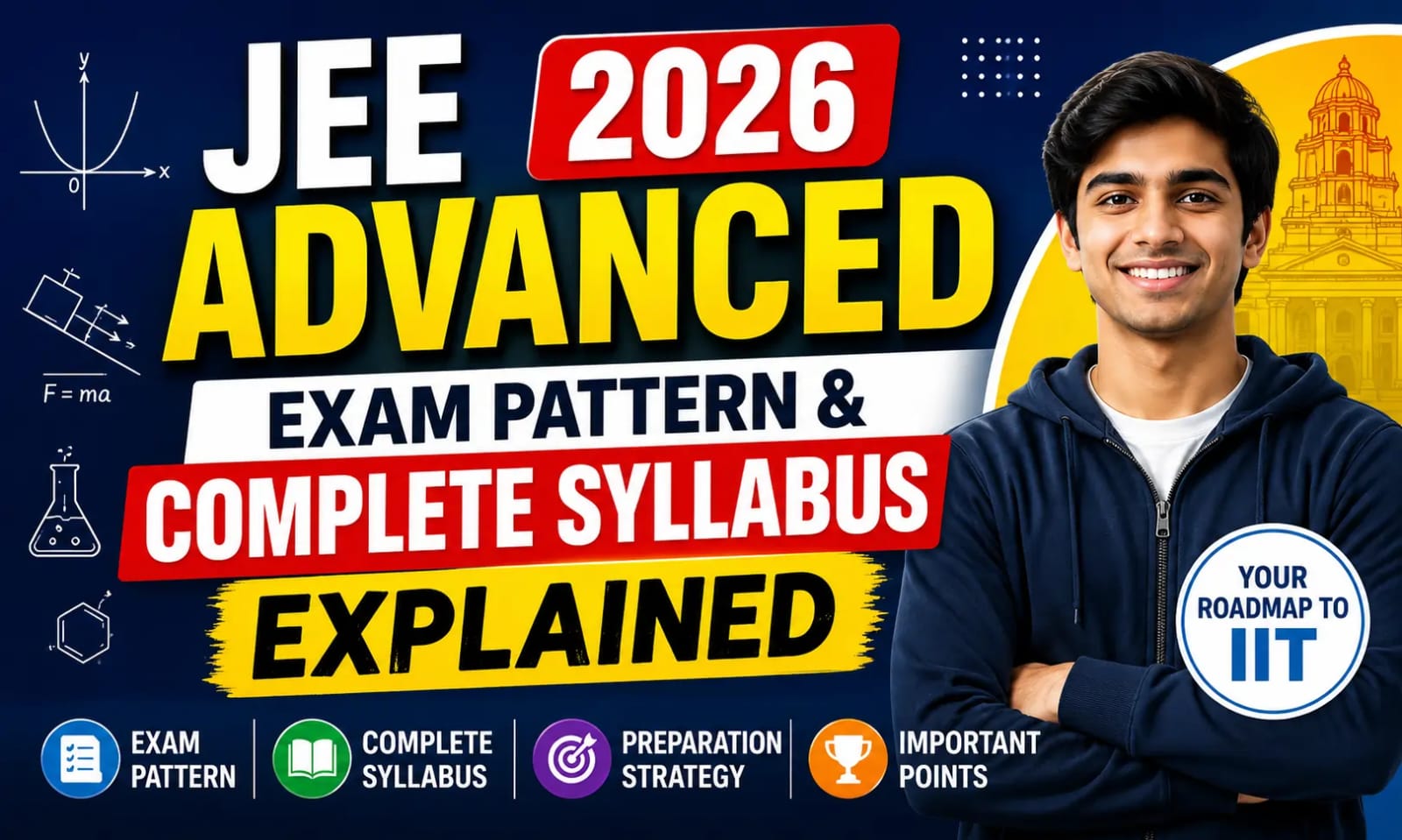
JEE Advanced 2026 Exam Pattern & Syllabus Explained: Big Changes – Full Details
Every year lakhs of students dream about IITs, but only a small percentage finally crack the toughest engineering exam in India. Now the biggest question among aspirants is, ‘What exactly will change in JEE Advanced 2026?’ From exam pattern confusion to syllabus pressure, students are already searching for the smartest strategy.
And honestly, ignoring these updates can seriously affect your preparation. If you are preparing for IIT admission, this detailed guide on the JEE Advanced 2026 exam pattern & syllabus explanation will help you understand everything clearly – without confusion and without unnecessary jargon.
JEE Advanced 2026 Exam Pattern Explained
The biggest reality of JEE Advanced is that the pattern changes slightly almost every year. That is exactly why students panic before the exam. However, some core things usually remain consistent.
- Mode of Examination
- Computer-Based Test (CBT)
- Conducted in two papers
- Both Paper 1 and Paper 2 are compulsory
- Questions appear in English and Hindi
Total Papers & Duration
| Paper | Duration |
|---|---|
| Paper 1 | 3 Hours |
| Paper 2 | 3 Hours |
- Subjects Included
- Physics
- Chemistry
- Mathematics
Types of Questions Asked in JEE Advanced
- Multiple-Choice Questions (MCQs)
- Numerical Value Questions
- Match the Following
- Paragraph-Based Questions
- Integer-Type Questions
Marking Scheme: The Real Game Changer
- Some questions carry negative marking
- Some offer partial marks
- Numerical questions may have no negative marking
- Instructions change section-wise
Physics Syllabus for JEE Advanced 2026
Laws of Motion, Work, Energy & Power Rotational Motion, Thermodynamics, Waves, Oscillations, Electrostatics, Current Electricity, Magnetism, Optics Modern Electromagnetic Induction Students should focus heavily on numerical practice.
Chemistry Syllabus for JEE Advanced 2026
Thermodynamics Electrochemistry Atomic Structure Hydrocarbons Alcohols & Ethers Aldehydes & Ketones, Amines, Biomolecules, Coordination Compounds Chemical Bonding p-Block Elements & f-Block Elements
Mathematics Syllabus for JEE Advanced 2026
Calculus Coordinate Geometry Algebra Vectors & 3D Probability Matrices & Determinants
Expected Important Changes in JEE Advanced 2026
- Concept-based numerical questions
- Increased application-oriented problems
- Time pressure through lengthy calculations
- More mixed-concept questions
Smart Preparation Strategy for JEE Advanced 2026
- Step 1: Strengthen Basics
Without strong Class 11 basics, advanced-level questions become difficult.
- Step 2: Solve PYQs Seriously
Previous year questions reveal the real IIT pattern. Students who solve PYQs regularly understand examiner psychology better.
Step 3: Mock Tests Are Non-Negotiable
Speed, accuracy, time management, pressure handling
- Step 4: Revision Strategy Matters
Most students keep studying new topics but forget revision. The smartest aspirants revise repeatedly instead of collecting too many books.
JEE Advanced 2026: Month-Wise Strategy
- If You Have 1 Year Left
- Complete syllabus in 7–8 months
- Keep last month’s for revision and mocks
- If You Have 6 Months Left
- Focus on high-weightage chapters
- Daily mock analysis becomes critical
- If You Have Less Time
- Prioritize PYQs
- Revise formulas aggressively
- Avoid learning entirely new difficult chapters
FAQs
- Will the JEE Advanced 2026 syllabus change?
Currently, no major official syllabus change has been announced, but students should regularly check IIT notifications.
- Is NCERT enough for JEE Advanced 2026?
NCERT is important for basics and chemistry, but advanced-level problem practice is also necessary.
- Which subject is toughest in JEE Advanced?
It depends on the student, but physics is generally considered the toughest because of conceptual and numerical problems.
- How many hours should I study daily for JEE Advanced 2026?
Quality matters more than quantity. Consistent focused study of 6–8 productive hours daily can be effective.
Conclusion
The truth is simple — cracking IIT is not about studying 18 hours daily. It is about understanding the exam smarter than others do. This detailed guide on the JEE Advanced 2026 exam pattern & syllabus evidence shows that success will depend on conceptual clarity, smart revision, mock analysis, and consistency.
Follow Us: Instagram
For more information, read a post. BSc Nursing Expected Cut-Off 2026: Big Government College Safe Marks & Rank Analysis
CBSE Class 12 Evaluation Issues 2026: Big Problems Affecting Student Marks, Rechecking & Latest Update