Table of Contents
India’s Longest-Range EV Can Travel 857 KM Without Charging
Range anxiety has been one of the biggest obstacles slowing down electric vehicle adoption in India. While charging infrastructure has improved significantly over the past few years, many buyers still hesitate before switching from petrol or diesel cars.
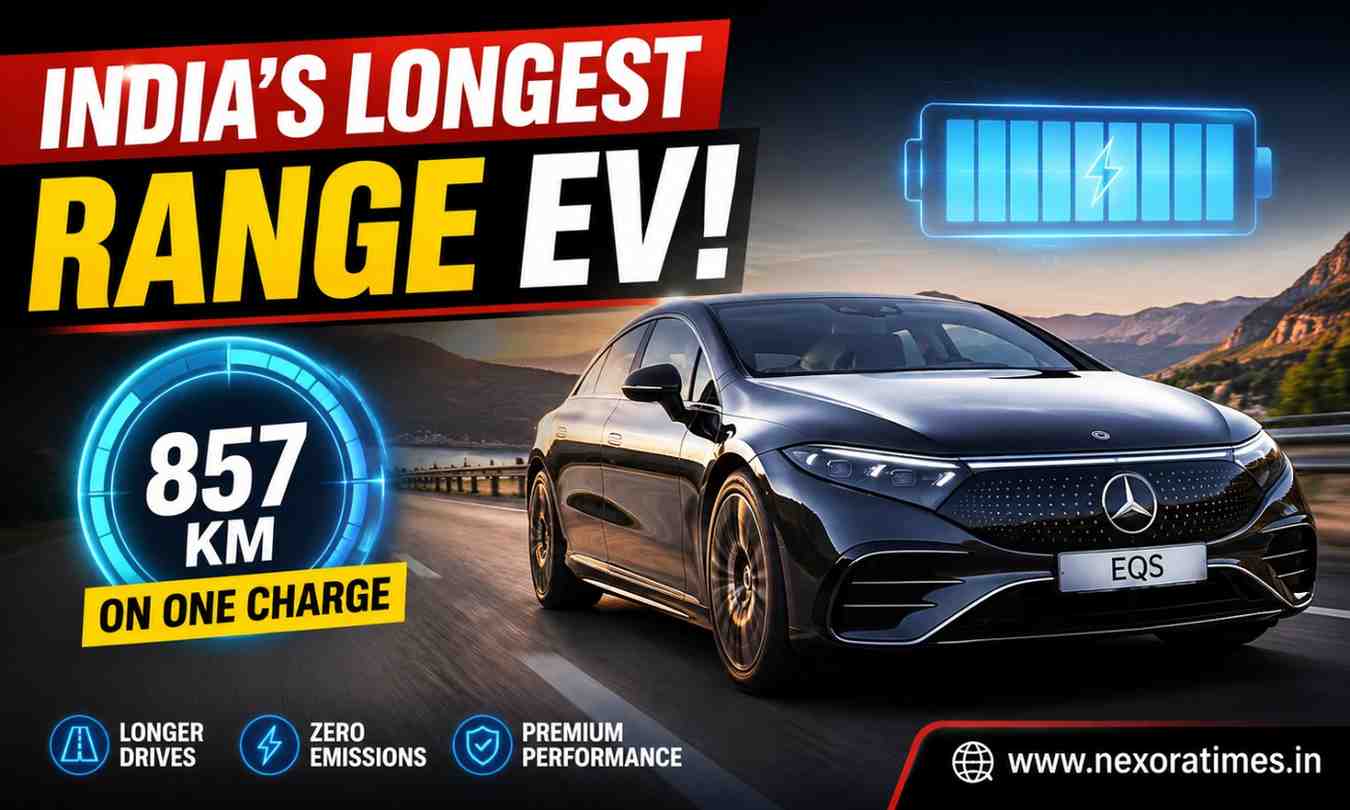
India now has an electric car capable of travelling an impressive 857 kilometres on a single charge, a figure that not only sets a national benchmark but also challenges long-held assumptions about EV practicality.
The vehicle in question is the Mercedes-Benz EQS, currently the longest-range electric car available in the Indian market. Its certified range has sparked fresh discussions among EV enthusiasts, luxury car buyers, and even first-time electric vehicle shoppers.
The emergence of ultra-long-range EVs reflects how quickly battery technology is evolving and how the Indian automotive market is entering a new phase of electrification.
Mercedes-Benz EQS: India’s Longest-Range Electric Car
The Mercedes-Benz EQS currently holds the record for the highest certified driving range among electric cars sold in India.
According to its ARAI-certified figures, the luxury electric sedan can travel up to 857 kilometres on a single full charge. The car uses a large 107.8 kWh battery pack and has been engineered with a strong focus on aerodynamic efficiency and energy management.
- Delhi to Jaipur and back without charging
- Mumbai to Goa with significant battery reserve
- Bengaluru to Hyderabad with minimal range concerns
- Most weekly urban driving without frequent charging
For many Indian consumers, such numbers directly address one of the biggest concerns associated with EV ownership.
What Makes the EQS So Efficient?
Advanced Aerodynamics
One of the biggest reasons behind the EQS’s exceptional range is its aerodynamic design. The vehicle has one of the lowest drag coefficients among production cars globally. Less air resistance means the battery expends less energy at highway speeds.
Massive Battery Capacity
The 107.8 kWh battery pack is among the largest currently available in India’s passenger EV segment. A larger battery naturally allows the vehicle to store more energy, enabling longer journeys between charging sessions.
Intelligent Energy Management
Mercedes-Benz has integrated sophisticated software systems that continuously optimise battery usage, regenerative braking, and power delivery.
Why the 857 KM Figure Is Creating Buzz
The significance of the EQS’s range isn’t limited to luxury buyers. Its 857-km claim has become symbolic of how far electric mobility has progressed in India.
A few years ago, EVs offering 200-300 km of range were considered impressive. Today, premium electric cars are approaching distances traditionally associated with internal combustion vehicles.
On social media and automotive forums, discussions increasingly revolve around whether “range anxiety” is becoming a thing of the past.
Real-World Range vs Certified Range
As with any electric vehicle, real-world performance can differ from official test-cycle figures.
- Driving speed
- Traffic conditions
- Air conditioning usage
- Passenger load
- Road gradients
- Weather conditions
Industry experts generally note that real-world EV range tends to be lower than laboratory-certified figures, especially during high-speed highway driving. However, even after accounting for these variations, the EQS remains among the strongest performers in the market.
India’s EV Range Race
The EQS may currently sit at the top, but it is no longer alone. Several manufacturers are aggressively pushing the limits of battery technology and efficiency.
Other Long-Range EVs in India
- Kia EV6
- Hyundai Ioniq 5
- Mahindra BE 6
- Mahindra XEV 9e
- BYD Seal
- Tesla Model Y Long Range
Many of these vehicles now offer certified ranges exceeding 600 km, a figure that was considered ambitious just a few years ago. The competition is intensifying, and consumers are ultimately benefiting from improved technology and better value.
Is Extreme Range Always Necessary?
Interestingly, not everyone believes that an 800+ km range will become the industry standard. Many analysts argue that as charging infrastructure expands, consumers may prioritise faster charging speeds rather than extremely large batteries.
After all, if an EV can gain hundreds of kilometres of range within minutes, buyers may no longer require oversized battery packs.
FAQs
- Which is the longest-range EV in India?
The Mercedes-Benz EQS currently offers the highest certified range in India, with an ARAI-rated driving range of 857 km on a single charge.
- What battery does the Mercedes-Benz EQS use?
The EQS is equipped with a 107.8 kWh battery pack designed for long-distance electric driving.
- Is 857 km the real-world range of the EQS?
The 857 km figure is an official certified range. Actual driving range can vary depending on driving style, weather, traffic, and road conditions.
- Are there affordable EVs in India with long range?
Yes. Models such as the Mahindra BE 6, Mahindra XEV 9e, Tata Harrier EV, and BYD Seal offer impressive range figures at lower price points than the EQS.
- Will future EVs cross the 1,000 km mark?
Globally, manufacturers are already testing EVs with claimed ranges above 1,000 km. Experts believe such technology could eventually reach mainstream markets.
Conclusion
The Mercedes-Benz EQS and its 857-kilometre range represent more than just a luxury achievement. They highlight how rapidly electric vehicle technology is advancing and how consumer expectations are changing alongside it.
As battery innovation accelerates and charging networks continue expanding, the next few years could redefine what drivers expect from an electric car.
Follow Us: Facebook
For more information: India’s Best Electric Cars in 2026: The EV That’s Winning Buyers Over
India EV Future 2026 Revealed: Why Electric Cars Are Becoming the Smartest Choice